

Knowing Gold Purity: Because 22KT and 18KT are not the Same!
Published by Shanthi Gold House | Reading time: 7 minutes
Article Metadata
- Author: Shanthi Gold House Editorial Team, in consultation with master jeweller Sudarakan Jothirajan
- Topics: Gold purity India, BIS hallmarking 2026, how to verify gold purity, 916 gold meaning, 22KT vs 18KT gold
Quick Answer (For Those in a Hurry)
The fastest, most reliable way to verify gold purity when buying in India is to check the BIS hallmark on the piece — specifically the HUID (Hallmarking Unique ID), a 6-character alphanumeric code stamped on every hallmarked piece. Enter it into the BIS Care app or website and you will instantly see the purity certification, the hallmarking centre, and the jeweller who made it.
This takes under 60 seconds. Every genuine jeweller will welcome you doing it. Any jeweller who discourages you from checking should be treated as a red flag.
Beyond the HUID, this article will walk you through everything a gold buyer in India needs to understand about purity, stamps, karats, and the warning signs of substandard gold — so you never pay 22KT prices for 18KT jewellery again.
The Numbers on Your Gold: What They Actually Mean
Walk into any jewellery store in India and you will encounter numbers like 916, 750, 585, and 999. These are not arbitrary. They are internationally recognised purity codes that tell you exactly how much gold is in the piece you are holding.
Here is the complete breakdown:
999 — 24 Karat Gold (99.9% pure) This is as close to pure gold as commercially available. It is soft, malleable, and not suitable for intricate jewellery — it bends and scratches easily. You will find 999 gold in coins, bars, and digital gold products. It is an excellent investment vehicle but a poor choice for wearable jewellery.
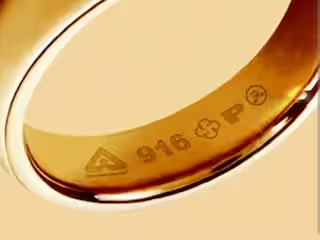
916 — 22 Karat Gold (91.6% pure) This is the gold standard — literally — for traditional Indian jewellery. The remaining 8.4% consists of silver, copper, or zinc, which adds durability without compromising the rich yellow colour that Indian buyers love. Temple jewellery, bridal sets, and most traditional South Indian designs are made in 916. When someone in Chennai says “gold jewellery,” they almost always mean 916.
750 — 18 Karat Gold (75% pure) Three-quarters gold, one-quarter alloy. This grade is popular for jewellery set with diamonds or precious stones, because it is harder and holds prong settings better than 916. It has a slightly paler yellow colour. At a lower gold content, it is also less expensive per gram — but making charges for diamond-set pieces often make the final price comparable or higher.
585 — 14 Karat Gold (58.5% pure) Less common in traditional Indian jewellery but increasingly seen in contemporary, lightweight fashion pieces. Noticeably paler in colour and significantly less valuable per gram than 916 or 750.
375 — 9 Karat Gold (37.5% pure) Primarily found in European and some imported jewellery. Rarely sold in mainstream Indian jewellery markets. If you encounter this stamp on something sold as “gold jewellery” at a traditional store, ask hard questions.
“In my four decades of experience, the most common confusion I see is buyers not distinguishing between 916 and 750. They look at the price and think they are getting a bargain — but they are getting less gold per gram and often paying a higher making charge on top. Knowledge protects you.” — Sudarakan Jothirajan, Proprietor, Shanthi Gold House
Understanding BIS Hallmarking: India’s Gold Purity Guarantee
Since September 2021, the Bureau of Indian Standards (BIS) has made hallmarking mandatory for all gold jewellery sold in India above a certain threshold. This was a landmark consumer protection move — and understanding it gives you real power as a buyer.
Every BIS-hallmarked piece carries four distinct marks:
1. The BIS Logo A small triangular mark that certifies the piece has been tested and certified by an authorised BIS Assaying and Hallmarking Centre.
2. The Purity Grade The number that tells you the gold content: 999, 916, 750, 585, or 375. This is the single most important mark on any piece of gold jewellery.
3. The HUID — Hallmarking Unique ID A 6-character alphanumeric code, unique to each piece of jewellery. This is the game-changer. Enter this code into the BIS Care app or at bis.gov.in and you instantly access the full certification record — which jeweller made it, which hallmarking centre tested it, on what date, and at what purity.
4. The Jeweller’s Identification Mark A mark unique to the jeweller, registered with BIS. This creates direct accountability — if a piece is found to be below the stated purity, the trail leads directly back to the manufacturer.
How to verify the HUID right now: Download the BIS Care app (available free on Android and iOS). Tap “Verify HUID.” Enter the 6-character code from the piece. The full certification record appears in seconds. Do this in the store, before you pay. Every reputable jeweller will not only allow this — they will encourage it.
What 40 Years Teaches You About Spotting Quality
Sudarakan Jothirajan has been handling gold jewellery since before most of his current customers were born. When asked what four decades of experience teaches you about quality that no certification can capture, his answer is immediate:
“Finish. Weight consistency. How the clasp feels when it closes. Whether the stone settings are even. A hallmark tells you about the metal. Your hands tell you about the craft.”
This is the irreplaceable value of buying from an experienced jeweller in person. Hallmarking certifies the gold content. But the craftsmanship — the soldering joints, the surface texture, the precision of filigree work, the security of gemstone mounts — is something only years of handling jewellery trains you to assess.
At Shanthi Gold House, every piece is BIS hallmarked and purity-certified. But the team also applies a secondary quality standard that goes beyond the certification — evaluating finish, structural integrity, and wearability before any piece reaches the display case.
If you want to understand what to look for before a major purchase, call or WhatsApp +91-9444302807 — Sudarakan Jothirajan’s team is happy to walk you through what to examine before you commit to any significant jewellery purchase, whether at their store or elsewhere.
Red Flags When Buying Gold: What to Watch For
Knowing what to avoid is just as important as knowing what to look for. Here are the warning signs that should make any gold buyer pause:
No HUID on the piece Since mandatory hallmarking came into effect, any jeweller selling unmarked gold is operating outside the law. This applies to both physical stores and online platforms. If a piece has no HUID, do not buy it regardless of how attractive the price or design.
Resistance to HUID verification A jeweller who discourages you from checking the HUID on the BIS Care app, or who becomes defensive when you ask to verify, is telling you something important about their confidence in what they are selling.
Making charges that seem suspiciously low This one trips up experienced buyers. A jeweller offering significantly below-market making charges on 916 jewellery is often compensating by shaving the actual gold content or inflating the gross weight. Verify the net gold weight on your invoice — this is the weight of the gold alone, excluding any stones or non-gold components.
No proper invoice or GST receipt Every gold purchase in India must come with a GST invoice that separately lists the gold weight, purity, making charges, and tax components. A jeweller who offers to sell “without bill” is almost certainly offering substandard gold or evading tax — neither of which is in your interest.
Gold that looks too yellow Pure-sounding but true: extremely vivid, almost orange-yellow gold is sometimes a sign of copper-heavy alloys that inflate apparent richness of colour while reducing actual gold content. Genuine 916 gold has a warm but not garish yellow. If a piece looks almost too golden, ask the jeweller to show you the HUID and verify it.
Pressure to decide quickly Legitimate gold purchases do not require on-the-spot decisions. Any jeweller who pressures you to buy immediately — because of a “scheme ending today” or a “last piece” — is using a sales tactic, not serving your interests.
The Invoice: Your Most Important Document After the Gold Itself
Many buyers focus entirely on choosing the right piece and forget that the invoice is nearly as important as the jewellery. A proper gold invoice should include:
- Name and address of the jeweller with GSTIN
- Date of purchase
- Description of the piece (type, design)
- Gross weight (including any stones)
- Net gold weight (gold only)
- Purity grade (916, 750, etc.)
- Gold rate applied (per gram, on the date of purchase)
- Making charges (as a percentage or fixed amount, clearly stated)
- Stone charges (if applicable, listed separately)
- GST at 3% on gold value and making charges
- HUID of the piece
- Total amount paid
If any of these elements are missing, ask for them explicitly before completing the transaction. A trustworthy jeweller will provide a complete invoice without hesitation. This document is your proof of purchase, your return/exchange basis, and your insurance record — keep it safely.
Old Gold Exchange: Does Purity Matter When You Sell?
Yes — significantly. When you bring old gold to a jeweller for exchange or buyback, the rate you receive is directly tied to the purity of your gold, verified by the jeweller’s in-house testing.
Most reputed jewellers use an XRF (X-ray fluorescence) machine to test old gold accurately and non-destructively. The machine provides a precise readout of gold content in seconds. You should ask to see this readout and compare it against the purity stamp on your original invoice.
If you purchased your original jewellery from a hallmarked, reputed jeweller with a proper invoice, this exchange process is straightforward and fair. If the original purchase was undocumented or from an unverified source, the jeweller will apply a conservative purity estimate — which typically means a lower exchange rate.
This is another reason why buying right the first time — from a verified, hallmarked jeweller — pays dividends when you eventually want to upgrade or exchange.
Frequently Asked Questions
Q: How do I check if my gold is real at home? A: The most reliable home check is the BIS Care app — enter the HUID from your piece to verify its certification. Beyond that, a magnet test (genuine gold is not magnetic) and a visual check for the purity stamp are reasonable starting points, but neither substitutes for professional verification or HUID checking.
Q: What does 916 mean on gold jewellery? A: 916 indicates 22-karat gold, meaning the piece contains 91.6% pure gold. This is the most common purity for traditional Indian gold jewellery and the standard used for bridal and ceremonial pieces across South India.
Q: Is 22KT gold better than 18KT for Indian jewellery? A: For traditional designs — temple jewellery, bridal sets, heavy necklaces — 22KT (916) is preferred because of its richer colour and higher intrinsic value. For diamond-set or stone-studded contemporary pieces, 18KT (750) is often better because it is harder and holds settings more securely.
Q: What is the HUID and how do I verify it? A: The HUID (Hallmarking Unique ID) is a unique 6-character alphanumeric code stamped on every BIS-hallmarked piece. Download the BIS Care app, tap “Verify HUID,” and enter the code to access the full certification record for that specific piece.
Q: Can a jeweller sell gold without hallmarking in India? A: Since September 2021, hallmarking is mandatory for gold jewellery sold in India (with limited exceptions for very small jewellers in specific regions). Any mainstream jeweller selling unhallmarked gold is operating illegally. Do not buy from them.
Q: How do I know if a jeweller is adding excess weight to my purchase? A: Ask for the net gold weight on the invoice — this is the weight of the gold alone, excluding stones and other components. Compare this against the per-gram gold rate to verify the gold value you are paying for. A reputed jeweller will provide this breakdown transparently.
Q: Does Shanthi Gold House provide BIS hallmarked jewellery? A: Yes. Every piece sold at Shanthi Gold House is BIS hallmarked with a verifiable HUID. Customers are encouraged to verify their purchase on the BIS Care app before leaving the store. Contact them at +91-9444302807 or visit www.shanthigoldhouse.com for more information.
The Bottom Line
Gold purity is not a complicated subject — but it is one that rewards a little knowledge enormously. Understanding the difference between 916 and 750, knowing how to verify a HUID, and insisting on a complete invoice are habits that will protect you on every gold purchase you make for the rest of your life.
The best jeweller you can buy from is one who not only provides all of this — but actively teaches it to their customers. Because a jeweller who educates you is a jeweller who is confident in what they are selling.
At Shanthi Gold House, every piece is BIS hallmarked, every transaction is fully documented, and every customer leaves knowing exactly what they bought. Over 40 years of serving families in Chennai and Sri Lanka — that transparency is the foundation. Visit www.shanthigoldhouse.com, WhatsApp +91-9444302807, or email sghchennai@gmail.com to speak with Sudarakan Jothirajan’s team before your next gold purchase.